Interactive WorkReach Model
Explore how distance, economic complexity (ECI), and informality shape work location choices across Mexican states. Adjust parameters to see how mobility flows change in real-time.
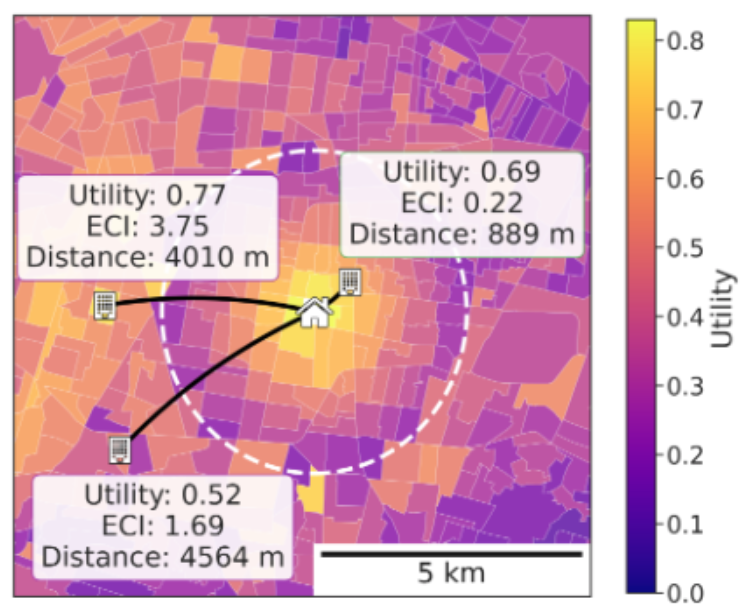
Cities don’t offer the same jobs to everyone. Commuters weigh how far a job is, how good the job is, and their own constraints (like informality at home) when deciding where to work. In our new paper, we introduce WorkReach, a discrete-choice framework that blends distance, Economic Complexity (ECI) at the destination, and informality at the origin to explain—and quantify—those trade-offs across Mexico City, Rio de Janeiro, Los Angeles, and the Bay Area.
What’s different here
Most flow models (gravity, radiation) are great at prediction but say little about why people choose specific work locations. WorkReach is built for interpretability:
- A utility function captures the decision of working at location j from home i.
- A transition weight (a logistic in distance) lets behavior shift from a “convenience-first” regime (nearby jobs) to an “opportunity-first” regime (farther, higher-quality jobs).
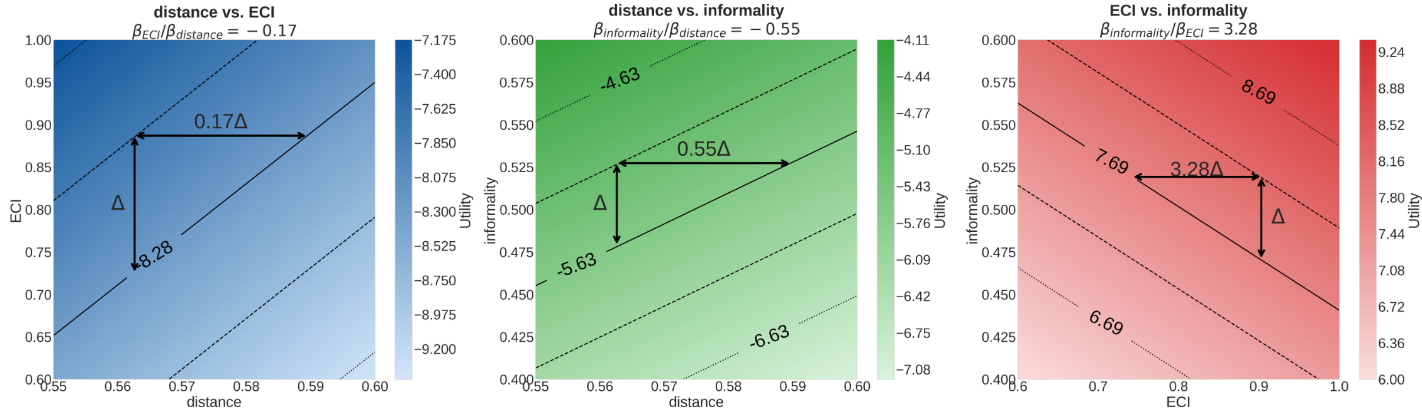
- We estimate city-specific parameters you can read directly: how much extra distance people will tolerate for higher ECI, and how origin informality changes that willingness.
Data, cities, and measures
We pair anonymized mobility/commuting flows with employment registries and census-based informality to compute:
- ECI (sub-city): diversity and sophistication of local economic activity.
- Informality (home areas): proxies based on social protection/registration data adapted to each country.
- Flows: observed or synthetic (U.S.) home→work trips mapped to consistent spatial units.

What stands out: Latin American metros show stronger spatial segregation (higher informality farther from high-ECI cores), while the U.S. metros are more mixed.
Key findings
1) Distance–complexity gradient
Everywhere, people prefer short commutes—but they will go farther for higher-ECI jobs. The marginal substitution between distance and ECI is largest in Mexico City, smallest in Los Angeles, meaning MC workers accept the biggest distance penalties to reach complex opportunities.
2) Informality flips by region
- Mexico City & Rio: Higher origin informality increases willingness to travel farther if the destination has high ECI (chasing better opportunities).
- Bay Area & Los Angeles: Higher origin informality reduces willingness to take long trips to high-ECI destinations (constraints dominate).
3) A behavioral “threshold” in distance
The estimated distance threshold (τ) marks when commuters switch from nearby-first to opportunity-first mode. It’s larger in Mexico City/Rio (longer convenience regime) and very small/sharp in U.S. metros (opportunities matter earlier as distance grows).
How well does it predict?
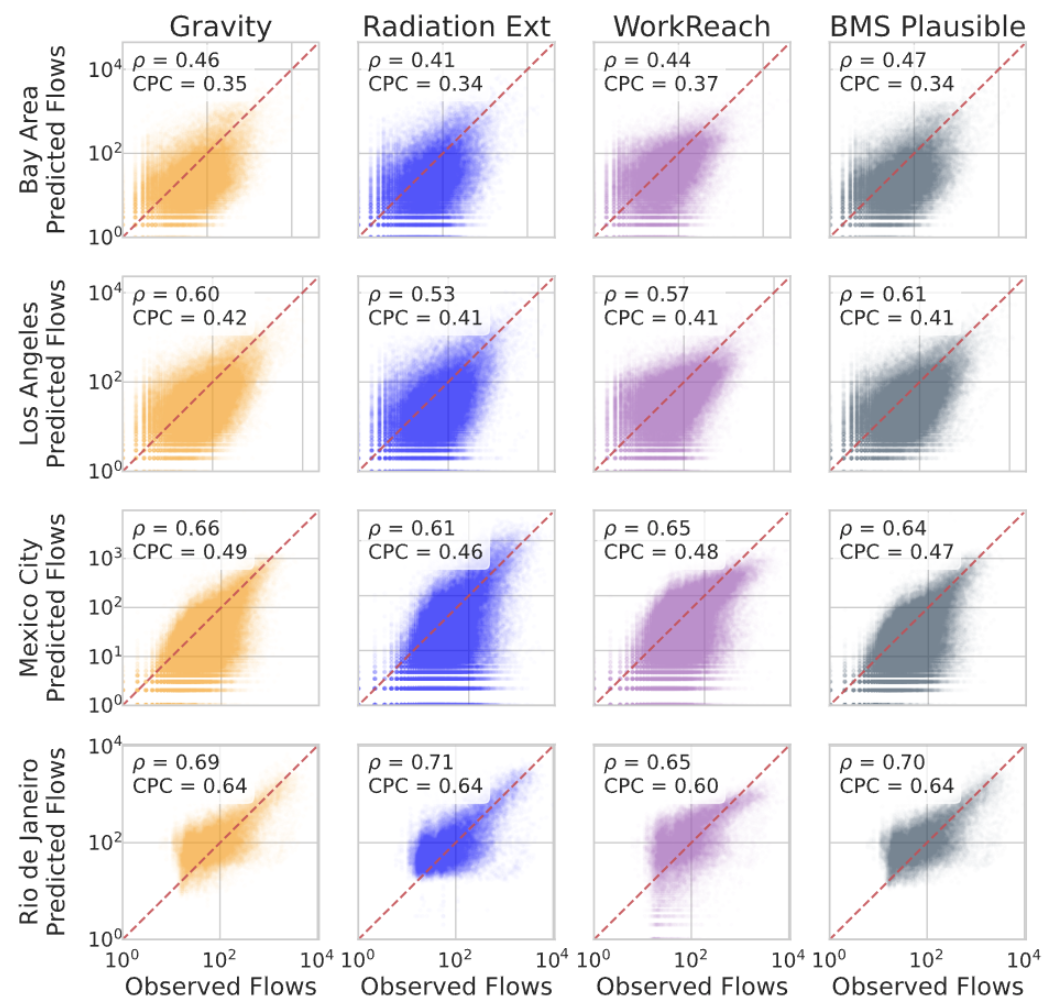
Despite prioritizing interpretability, WorkReach matches benchmark gravity/radiation models in CPC and correlation—and in the Bay Area, it takes the top CPC. The payoff is that we can read why choices look the way they do—not just that they do.
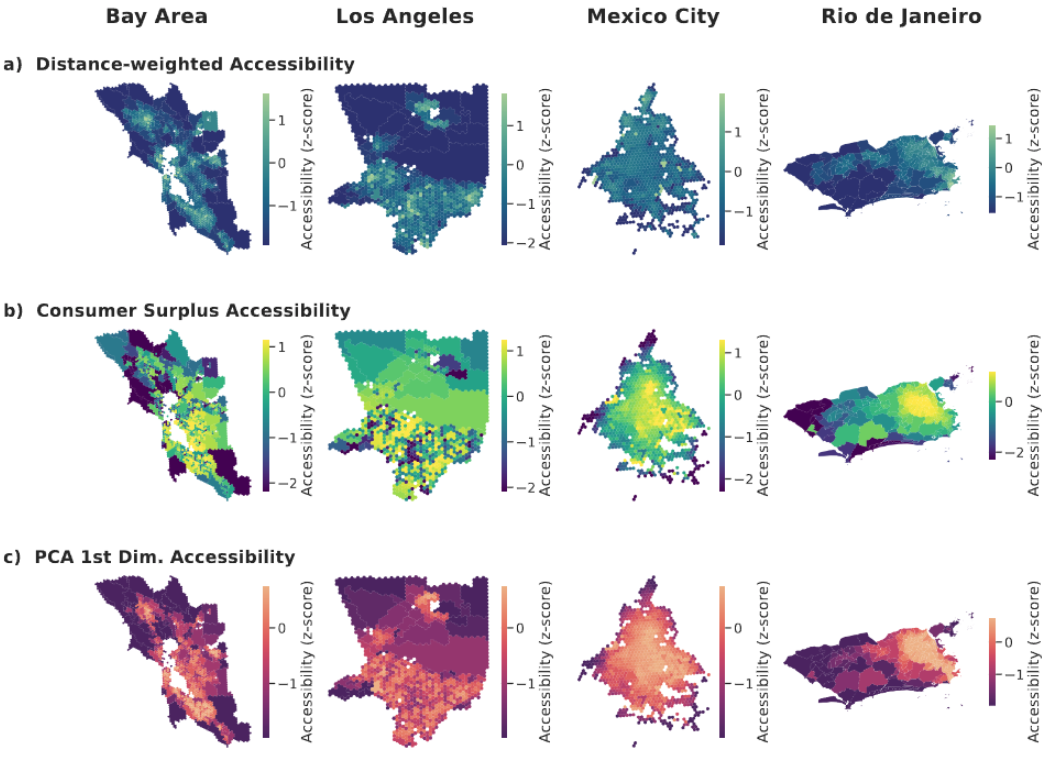
Accessibility: distance isn’t the whole story
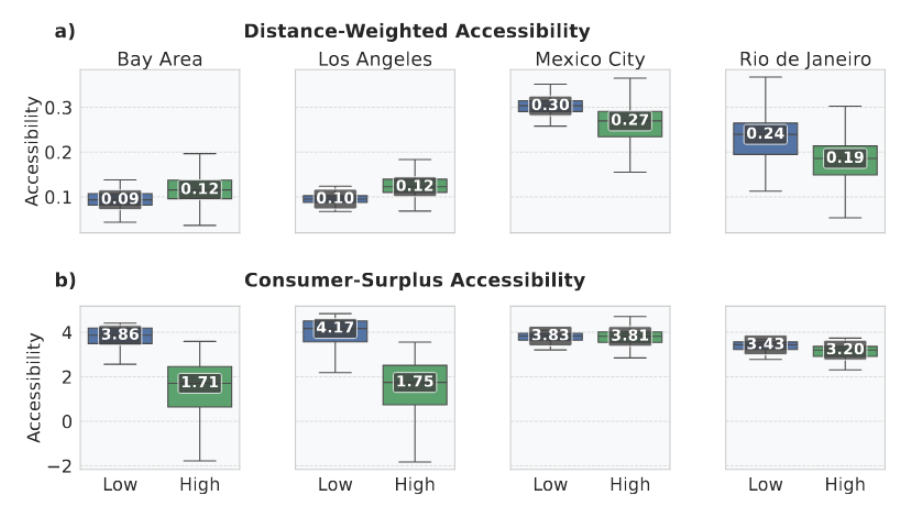
We compute two complementary metrics:
- Distance-weighted accessibility (closer flows count more)
- Consumer-surplus accessibility (a logsum from discrete choice): the expected max utility across all job options, integrating distance, destination ECI, and origin informality.
Result: Consumer-surplus accessibility is consistently lower for high-informality origins in all four cities, even where simple distance metrics look favorable. Quality and constraints reshape who truly benefits from the urban job market.
Why this matters for policy
- Target connections where they unlock quality: Improve access from high-informality origins to high-ECI destinations (Latin America), and reduce non-distance barriers for informal workers in U.S. metros.
- Invest where the trade-off is steep: Places with high ECI but poor consumer-surplus for vulnerable groups are prime for transit improvements; areas with good physical access but low ECI call for local economic development.
- Measure the right accessibility: Pair distance metrics with utility-based measures to avoid overestimating access where job quality is out of reach.
Paper: “WorkReach: Modeling Urban Work Location Choices Through Economic Complexity, Informality, and Mobility Data.” (Mexico City, Rio de Janeiro, Los Angeles, Bay Area). :contentReference[oaicite:1]{index=1}